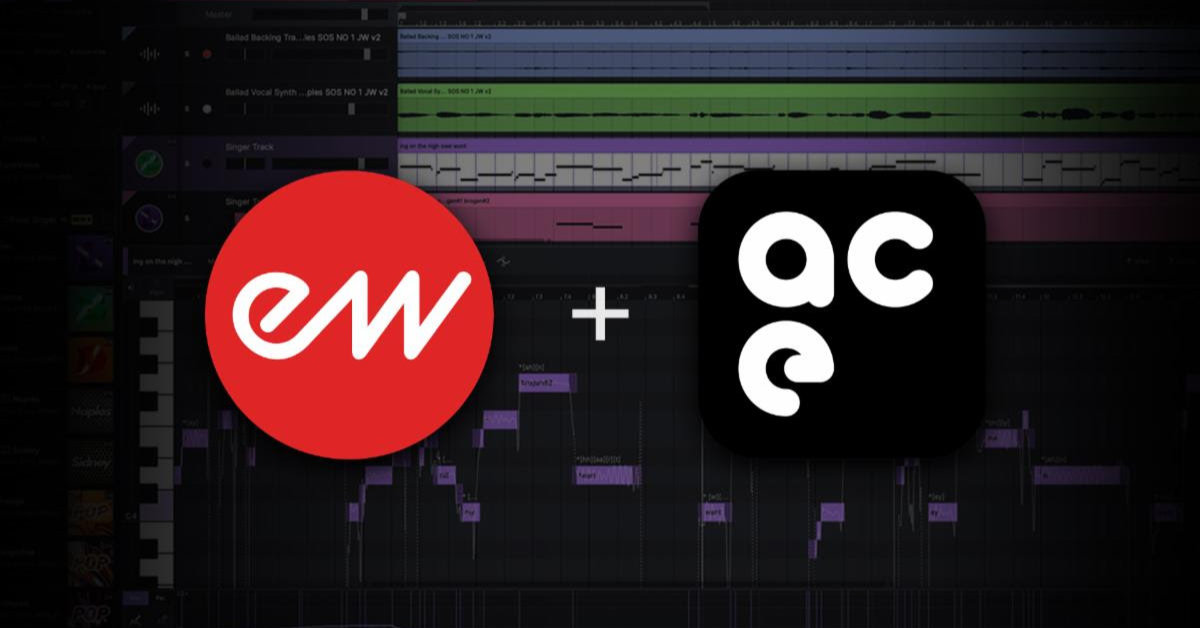
On January 21, 2026, a business partnership between ACE Studio and EASTWEST Sounds was announced.
At first glance, this might seem like just another piece of news about how “AI is changing music production.” However, a closer look at the announcement suggests that the direction of this partnership is quite different from generative AI models like Suno, which are currently making waves on social media.
ACE Studio explicitly positions itself as a production tool for “expressive performance” rather than a tool for automatic track generation. Instead of generating full tracks with a single click, the emphasis is on MIDI-based operation, editable AI instruments, and professional-grade expression controls.
The fact that their partner is EASTWEST—a company that has supported professional production environments for many years—further underscores ACE Studio’s positioning in the industry.
What is fascinating here is that even within the broad category of “AI-driven music production,” entirely different cultures can emerge depending on the underlying design philosophy.
Music generation AI like Suno adopts a model that generates music in bulk based on natural language prompts. Users provide text instructions, evaluate the resulting audio, and re-generate if they aren’t satisfied. This process is incredibly accessible and has significant meaning in terms of dramatically lowering the barrier to entry for music creation.
On the other hand, this structure also brings the act of creation closer to “stochastic trial and error.” No matter how much one refines a prompt, the internal generation process remains a black box. The quality of the final sound is, to some extent, subject to the “luck of the draw.”
The psychological structure of pressing the generate button with anticipation, receiving a result, and spinning it again if unsatisfied is remarkably similar to the mechanics of a “gacha” (a luck-based lottery).
This isn’t just a metaphor; it may be deeply linked to the monetization structure. In a model where the number of generations is directly tied to consumption, the user is naturally positioned as a “consumer.” In other words, the design prioritizes immediate satisfaction with the result over the creative process itself.
The question I want to raise here is not about the morality of “gacha-style” creation, but rather how compatible it truly is with the act of “creation.”
The direction taken by ACE Studio is a stark contrast to this structure. It maintains a production process continuous with traditional DAW culture—MIDI-based operations, editing performance nuances, and meticulously designing timbre and expression. Here, AI does not generate the music as a whole; instead, it serves to extend the precision, efficiency, and realism of performance and editing.
In this case, the user’s input shifts from “stochastic manipulation” to “causal manipulation.” Since there is a tangible sense of “if I change this, the sound changes like that,” the process of trial and error feels less like spinning a lottery and more like the iterative refinement of a sculpture.
We can also view the difference between the two as a “difference in operational resolution.” Generation via natural language has low operational resolution, leaving the result to probability. In contrast, MIDI and editing-based operations offer high resolution, making the causal relationship easier to grasp physically and intuitively.
In essence, the lower the operational resolution, the more the human becomes the “one waiting for the result.” The higher the resolution, the more the human stands as the “one designing the process.” This difference is not merely a matter of user interface; it affects the very nature of the creative subject.
From this, a hypothesis emerges.
In the future, Suno-style AI may gravitate toward becoming a form of “music (BGM) generation infrastructure.” Meanwhile, ACE Studio-style AI may occupy a position closer to the “evolution of the instrument itself.” The former will grow and spread as industrial infrastructure, while the latter deepens as a cultural apparatus.
If this is the case, the two will not be in simple competition, but will likely run in parallel, fulfilling different roles.
While an environment is being established where anyone can instantly generate music, the value of “designing, editing, and constructing” music will be redefined in a different form. We may be standing at that very crossroads.
The partnership between ACE Studio and EASTWEST demonstrates a realistic product design that views AI not as something that “eliminates the work of musicians,” but as something that “continues to extend the work of musicians.”
Does AI create music, or does it extend the musician? This question is more than a technical debate; it is an inquiry into the design philosophy of future music culture, and one we must continue to watch closely.
Related Articles