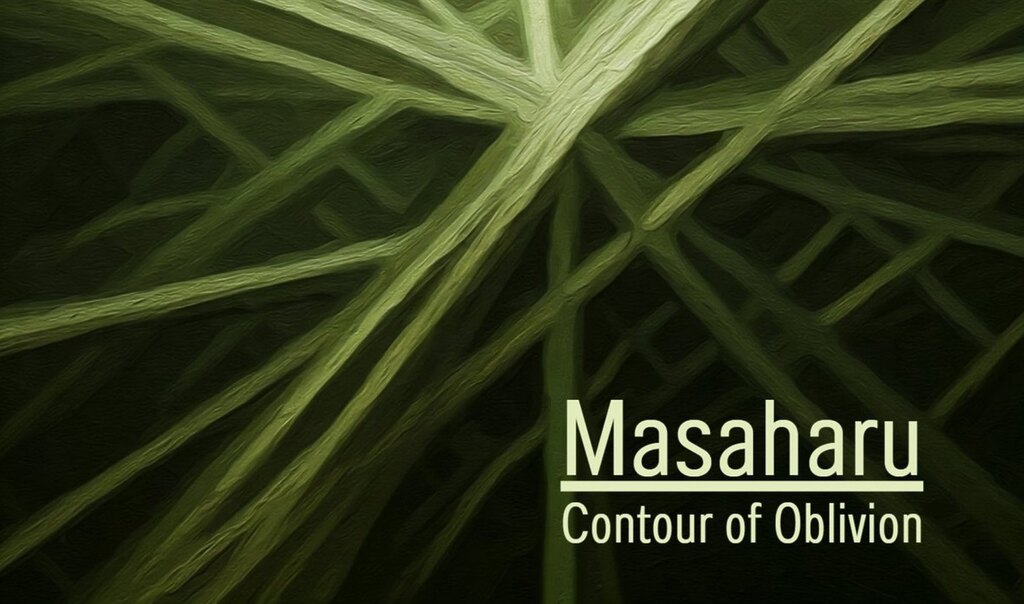
This collection is a pursuit of one of the author’s core themes—”delicately fluctuating structures and developments”—expressed through the lens of IDM (Intelligent Dance Music).
The opening track, “Contour of Oblivion” (Original title: 『忘却の輪郭』), begins with a guitar phrase that is leisurely yet possesses a certain heavy, sluggish quality. While it initially seems to progress with a shadowed atmosphere against a rhythmic backdrop, the scenery suddenly shifts. An intrusive, improvisational synth bass and synth pads burst in, creating a moment where time seems to freeze. This evokes a sense of unease and tension before the piece seamlessly returns to its original sonic space.
A defining characteristic found in much of Masaharu’s electronic music is that, while it may appear to inhabit the realm of ambient music, it never easily surrenders to a comfortable, “chill-out” mood. Rather than staying within a simple atmosphere, the work attempts to capture complex, ambiguous mental imagery and its temporal shifts. This is achieved through morphing-like transitions and block-style structural breaks. If one were to describe this quality in a single word, “introspective” would be most fitting. The introduction of new musical elements is never rushed; it proceeds with restraint, building time through a limited set of materials. The track finally closes quietly through the repetition of a motif that carries a sense of “serene tension.”
The second track, “Tangle of Gazes” (Original title: 『錯綜する眼差し』), carries a similar air to the previous piece but moves within an up-tempo flow. Here, fragmented vocals are juxtaposed, stripped of their lyrical meaning. As a result, these vocal fragments function purely as textural elements; they lack scat-like melodic lines and offer no linguistic meaning that could be called rap. They are simply stacked and layered like building blocks.
In this relatively fast-paced flow, scenes are shifted by the entry and exit of multiple drum parts and guitar riffs. However, the inorganic resonance of the vocals blankets the entire piece, creating a sense of stagnation that feels at odds with the beat. It leaves an impression akin to seeing a cold light through a veil of thin clouds.
In the third track, “Liminal Dream” (Original title: 『夢のあわい』), vocal fragments are again employed, but the atmosphere is entirely different. Throughout the piece, the harmony created by acoustic guitar and synth pads is prioritized, and the flow of the song is entrusted to that resonance. The harmonies progress as the constituent notes morph into one another; before you realize it, the sound has shifted and evolved. The guitar cutting acts as a sort of pedal point, supporting the axis of the morphing harmonies while contributing to a hypnotic, constant rhythm.
As the title suggests, there are no uplifting elements here, such as excessive stimulation or emotional agitation. Even when moments occur where the rhythm seems to dissipate, the swaying resonance persists, leaving an impression much like a light slumber. As the delicate, ambiguous sounds—which cannot be categorized by simple words like “bright” or “dark”—begin to harmonize with the vocal fragments into a single rhythm, the piece reaches its end. It is a strange sensation of abruptness, much like opening one’s eyes in the middle of a dream.
It is fascinating to observe how these three tracks, while utilizing common musical materials and construction techniques, each attempt to cultivate a distinct musical mood.